Alex's Notes & Musings on Ten Minutes by Tractor
This wonderful estate began in 1999 when three neighbouring vineyards on the Mornington Peninsula - each literally ten minutes by tractor apart - teamed up to bottle all of the fruit under a single label.
It was founded by IT expert Martin Spedding and his wife Karen and they have since transformed it into one of Australia’s most critically acclaimed cool‑climate producers.
On the way though, in 2018, disaster struck when a fire totally levelled the original cellar door and restaurant, so they had to rebuild from scratch. The silver lining was that they had the opportunity to create a more modern, more sustainability-driven facility that is now a regional benchmark.
The Mornington - commonly known in the Melbourne area as just 'The Peninsula' or 'MP' - is a wine lover and foodie's paradise.
I dream of one day spending a few months in or near Melbourne so that I can spend weekends visiting producers and having long, boozy lunches in the sunshine! Especially as in almost every direction and within reach of Melbourne is high-quality, largely small-producer Pinot Noir and Chardonnay country...to me, the greatest cultivars of them all.

Winemaking & Ethos
Burgundian sensibility but with unmistakable Australian brightness.
What appeals to many is the small-scale, unshowy but quietly confident approach of the producers on the Peninsula, most family-owned and run, and several if not most of which are undoubtedly world-class.
To some, Australia is perceived as being all about massive, corporate winemaking behemoths churning out mass-market brands. These exist of course, but actually there is a hell of a lot more to Australia's vinous landscape than this, particularly (but far from exclusively) in the Victorian wine regions surrounding Melbourne.
And here at Ten Minutes by Tractor, the 'minimal intervention' phrase pops up yet again, mentioned in many of my other producer profiles.

Wild Yeasts & A Discussion on Malolactic Fermentation
At Ten Minutes by Tractor we're talking small-batch vinification for terroir and cool-climate expression and thus restrained alcohol (12 to 13% abv), wild ferments (i.e. the use of indigenous yeasts, for spontaneous rather than winemaker-induced fermentation, that are naturally present in the vineyard and winery rather than shop-bought 'cultured' yeasts), gentle handling, and the use of oak only to support/frame the wine not to flavour it. Style-wise what many look for in a wine and right on-the-money in terms of style and global winemaking trends.
As an aside, spontaneous fermentation by wild aka indigenous yeasts carries much more risk and requires much more focused and attentive winemaking, and increases the winemaker's stress levels no-end as bad things can happen (the fermentation stage tends to be much longer), but it is worth it for the enhanced complexity and terroir expression it brings to the wine. Most of my favourite wines are made this way.
Ten Minutes by Tractor is now highly revered for wines of purity, tension, and very fine rather than muscular structure.
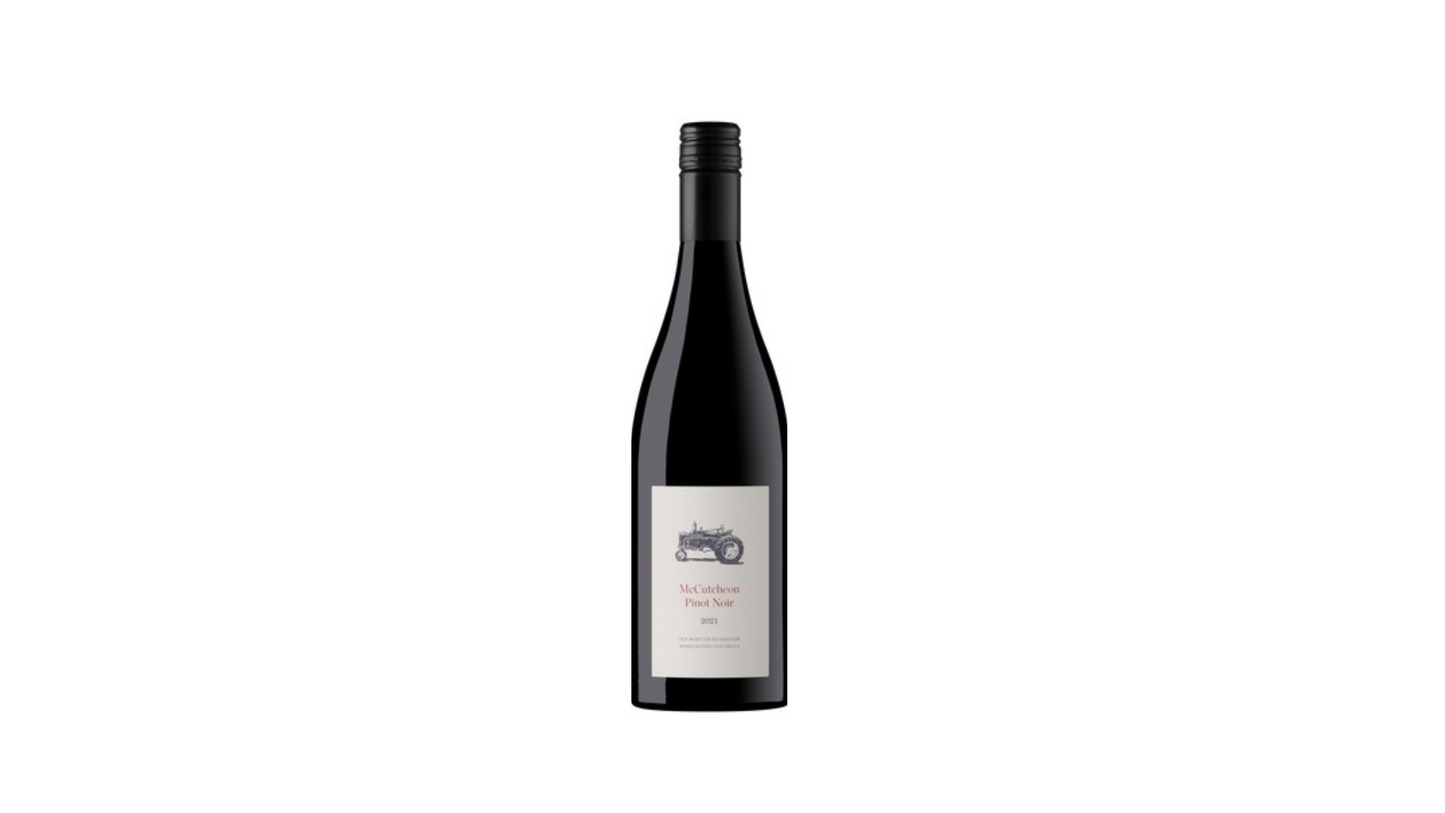
The winemaking breakdown for the McCutcheon Pinot Noir:
20% whole bunches • 30 days on skins in concrete • following pressing, the wine was transferred to 25% new 228 litre French oak barrels for 8 months • natural malolactic fermentation before bottling unfined and with minimal filtration.
NB malolactic fermentation (MLF) is the conversion of sharp malic acid (the acid dominant in green apples) to softer lactic acid (the acid dominant in milk) by lactic acid bacteria (LAB) such as Oenococcus oeni and Lactiplantibacillus plantarum. MLF therefore softens a wine.
MLF can be induced by the winemaker through adding LAB cultures (that come in a packet!) or it takes place naturally (but often more slowly and less predictably). Some winemakers who like to stay safe add the LAB at the same time as alcoholic fermentation so that MLF takes place around the same time.
Some LAB that can be naturally present in wine are spoilage organisms so it helps to know what you've got in the wine by doing frequent analysis; the risk of these causing spoilage can then be minimised by adding the right amount of sulphur dioxide (SO₂) to which these spoilage LAB have low resistance and therefore can't reproduce.
High pH wines are always at more risk of spoilage as bacteria thrive much more at higher pH (3.4 and above) than at low pH - which is why higher pH wines have more SO₂ added as protectant (SO₂ being antimicrobial and antioxidant). Winemakers tend to use Lactiplantibacillus plantarum to complete MLF in high pH wines as this LAB is particularly effective at higher pH.
Temperature is important for MLF to take place - LAB are active above 16°C and optimal up to about 20°C. Winemakers can therefore delay MLF by holding the wine below 16°C to inhibit bacterial activity.
Some winemakers will avoid MLF entirely (e.g. for high acid styles and sparkling wines) by adding SO₂ early on - SO₂ being the primary tool for suppressing the bacteria. In any case, the bacteria struggle at a pH of less than 3.1 and under a pH of 3 is strongly inhibitory. Total SO₂ of around 40 mg/L becomes unfavourable for MLF while 50–60 mg/L can completely inhibit MLF.
Though an important caveat is that SO₂ effectiveness depends on pH, which is why winemakers always want to know what the pH of the grape juice and then the wine is. Another option and perhaps the most reliable way is to sterile filter (although this requires expensive equipment and can strip character), or you can use antimicrobial additives that suppress LAB such as Chitosan (in the form of commercially available professional winemaking products).
Ultimately, what a winemaker really looks to avoid is MLF taking place after the wine is bottled - as a by-product of MLF is carbon dioxide and this will make the wine fizzy when it's not meant to be, not to mention likely making it taste awful as well if the wrong LAB have been responsible!

Sustainability
With few exceptions, perhaps unsurprisingly I see family-owned wineries as the most concerned with sustainability and environmental stewardship. It doesn't seem to be for marketing, just to "tick the boxes" - they live and breathe it. And it is undoubtedly more practical and achievable on a smaller scale.
Ten Minutes by Tractor is run along organic and regenerative lines which we know involves: focussing on soil health and biodiversity, zero use of herbicides, cover cropping, water efficiency, much work by hand on canopy management to reduce disease naturally rather than via frequent spraying, crucial for Pinot Noir as its tight bunches and thin skins are prone to disease (a major reason why it's expensive to make, and thus to drink).
As with other producers of their ilk, the philosophy is simple: healthy soils and balanced vines that are not dependent on chemical applications = much more robust, disease-resistant vines that produce concentrated fruit and can grow old = wines with character, finesse, longevity, that don't have carcinogenic or endocrine-disrupting pesticide residues.

Terroir - the environment that dictates viticultural and winemaking methods, and shapes the wine
10 Minutes by Tractor farms several of the Peninsula’s most prized sites, each with distinct mesoclimates and soil profiles.
The wine in your case is grown in the McCutcheon vineyard which has a high elevation (for the region) at 200-250m and is strongly influenced by cool maritime breezes that help to moderate ripeness and thus alcohol, and in retaining acidity, both vital to achieve that unmistakable Pinot Noir perfume and character.
Soils are volcanic - very red in appearance - and they produce taut, mineral Chardonnay and profound, structured, ageworthy yet fine-boned Pinot Noir.
The region’s maritime climate - cool breezes, long ripening seasons, and strong diurnal (day-night) temperature shifts - underpins the estate’s hallmark freshness and precision.

Winemaker's Tasting Note
"A symphony of rose petal, sweet rhubarb, spiced sumac, bramble, and autumnal characters lift from the glass. This is a classic McCutcheon Pinot with elegant red fruits and a finely detailed structure. There is an ever changing range of secondary and fruit characters that evolve beautifully in the glass, given time. It is a complex wine that is alluring, light on its feet and leads a merry dance right to the end".

A Few Reviews
"Another low-alcohol Mornington Peninsula Pinot that looks riper than the numbers suggest (in a good way). The McCutcheon vineyard is the highest of the Ten Minutes By Tractor plots and has an easterly aspect. This Ten Minutes By Tractor McCutcheon Pinot Noir 2021 is still only a light wine, with a nose of bacon bits, raspberry, rhubarb and a sheen of vanilla oak. But light and low alcohol don’t mean unwelcoming wine – the palate is fine-boned, with tomato juice, cranberry and lamb juices edge giving a Pinot Noir of some grace and sinew. It’s so Pinoty, and such an interesting and enjoyable wine, if still svelte. Best drinking: good now, likely better in 2-3 years. It’s not going anywhere, but I’d still drink this style younger", 18.5/20, 94/100. Andrew Graham, 2023, Australian Wine & Drinks Review.
"Elegant, balanced and developed. On the palate, vibrant, fresh, fruity soft supple tannin, great work with oak integration", London Wine Competition 2023.
"The bouquet is dark and dense, redolent of ripe berry fruits and undergrowth. There’s something so vivid about the aroma here, recalling the physicality of walking through a densely planted forest. It’s also relatively restrained given the density of its aromas. There’s also a savoury dimension that isn’t immediately apparent, but which grows as the wine gains air. The palate, a suitably impressive experience, that density of aroma translating to masses of flavour and structure on the palate. This is a serious wine, and one that has so much more to give, despite the attractiveness of its present flavours. Tannins are a particular highlight, being fine and ripe, as is a certain strand of sappy flavour that runs alongside berry fruit and contributes the most delicious freshness", Ministry of Drinks, 2023.

#WineObsessed
Australia: Ten Minutes By Tractor - McCutcheon Pinot Noir 2021, Mornington Peninsula (Vegan-friendly)